Thursday, February 2, 2012

Using Citations


In analysis, it is very important to correctly FORMAT each citation or passage that you use directly
from the text.  Here are some steps to help you along.

Punctuating a Citation without Dialogue
STEP ONE: Copy the citation EXACTLY from the book, but leave off the end punctuation mark.  For example (from the novel Crossing Jordan by Adrain Fogelin):

He held out his right hand.  Mr Lewis hesitated before taking it. After a quick handshake, they stood facing each other, not knowing what to do next

STEP TWO: Next, add quotation marks to the beginning and end of the citation.

“He held out his right hand.  Mr Lewis hesitated before taking it. After a quick handshake, they stood facing each other, not knowing what to do next”

STEP THREE: After the end quotation marks, add parentheses with the page number(s) to indicate where you found the citation

“He held out his right hand.  Mr Lewis hesitated before taking it. After a quick handshake, they stood facing each other, not knowing what to do next” (104)

STEP FOUR: Finally, add a period after the parentheses.


“He held out his right hand.  Mr Lewis hesitated before taking it. After a quick handshake, they stood facing each other, not knowing what to do next” (104).


Punctuating a Citation with Dialogue
The only difference in punctuating a citation with dialogue is that you use single quotations (‘ ‘) instead of double quotations (“ “) for the dialogue portion.  You still need to use double quotations to indicate that it is a citation.  

For example:

“I owe you my baby’s life.’ He held out his right hand” (104).

OR

“And even though I thought she did, I said, ‘She’s fine, Lou Anne.  Perfect,’ because I didn’t want Lou to feel bad anymore” (105).

  • When introducing quotations, be sure to use a comma to separate your introductory context and the citation.


Example: Nana Grace explains, “She went to school every day afraid.  Afraid to use the little girls’ room. Afraid of fights on the playground” (111).


  • When citing poetry, use slash marks (/) to indicate line breaks.


Example: “His bald head the brightest/spot in the room./He’s thick as a broomstick, gangling tall,/his eyes cloudy” (99).  
~Hesse, Karen. Witness


  • If there is a question mark or exclamation point at the end of your citation, keep the orginal punctuation INSIDE your quotation marks and use a period OUTSIDE your last parentheses.


Example: As she listens to Nana Grace sing a soothing tune, Lou Anne askes, “What’s that song about Crossing Jordan mean?” (103).

OR

Dorothea in Mary Shelley’s Frankenstein responds to her sister, “What a wonderful little almanac you are, Celia!” (7).

  • If you want to use the beginning and ending of a larg passage (but don’t necessarily need the entire thing), you may use an ellipsis (…) to indicate that you are skipping a section

Example: In reflection on her talent show fiasco, the narrator realizes, “In the years that followed, I failed her so many times, each time asserting my own willl, my right to fall short of expectations…for unlike my mother, I did not believe I could be anything I wanted to be” (100).
~Tan, Amy. “Two Kinds” from The Joy Luck Club

  • If your citation goes onto a second page, include both page numbers separated by a hyphen.

Example: After the narrator finishes her doomed recital, she stands to a quiet, shocked room.  “And now I realized how many people were in the audience, the whole world it seemed” (98-9).

  • Set off longer quotations as a block.  For quotations of four lines or more, start a new line, indent the entire quotation ten spaces from the left margin, continue to double space, and do not use quotation marks.

Example
There is no question that Franklin found the Iroquois impressive.  On March 20, 1750, he wrote to James Parker, his friend and fellow printer:
It would be a strange thing if Six Nations..should be capable of forming a scheme for such a union, and be able to execute it in such a manner as that it has subsisted ages and appears indissoluble; and yet that a like union would be impracticable for ten or a dozen English colonies, to whom is more necessary and must be more advantageous, and who cannot be supposed to want an equal understanding of their interests. (444)

Plagiarism

Plagiarism is using someone else’s ideas or words as though they are your own.


1.  Any time you use sources in your writing, whether a quotation, paraphrase, or summary, you must credit your sources. There are many online MLA format sites that can assist you in documentation. Google: “MLA format” and you will be linked to a variety of sites.
2.  All parties in plagiarism are considered equally guilty. If you share your course work with another student, you are considered as guilty as the person who plagiarizes it, since you enable the plagiarism to take place.

Capitalizing Titles


Capitalizing Titles

Capitalize the first word, the last word, and all important words in titles and subtitles of book, magazines, newspapers, poems, short stories, plays, movies, television programs, works of art, and musical works.
                    
The rule is simple enough, but how do you know which words are considered important? You know what is important by knowing what is unimportant.


Unimportant words in a title are not capitalized and include the following:
  • The articles (a, an, the)
  • Coordinating conjuctions (and, but, for, nor, or, so, yet)
  • Prepositions with fewer than five letters (at, by, down, for, from, in, into, like, of , off, on, over, past, up, upon, to, with).

Examples of Capitalization of Titles
BooksThe Horse and His Boy                                   Dust Tracks on a Road
MagazinesReader’s Digest                                                 Sports Illustrated for Kids
NewspaperDetroit Free Press                                              Pittsburgh Post Gazette
Poems“The Sky Is So Big”                                           “For a Poet”
Short Stories“The Six Rows of Pompons”                             “The Day the Sun Came Out”
PlaysOnce on This Island                                           A Chorus Line  
MoviesNight at the Museum                                        Harry Potter and the Order of the Phoenix
Television ProgramsRaising Hope                                                      Extreme Home Makeover
Works of ArtDelfina and Dimas                                             Forever Free
Musical WorksPeter and the Wolf                                            “Oh, What a Beautiful Morning”


Formatting Titles

These conventions make titles stand out from other words and give readers information about the work mentioned.


Capitals
  • Capitals set titles apart
  • The first and last words of a title are capitalized
  • All other important words should also be capitalized
  • Do not capitalize small words, however, “to” is capitalized when it is used before a verb.
  • In a title IS is capitalized since it is a verb
  • Titles of students’ papers are capitalized by the same guidelines.  Underlining, bolding, special fonts, italics, and quotation marks are not used.

Examples
A student’s title on the paper - -  Hotel by the Railroad
Fiction book - - To Kill a Mockingbird
Poem - - “Ode on a Grecian Urn”
Play - - Romeo and Juliet
Short story - - “The Ransom of Red Chief”
Nonfiction book - - A Night To Remember
Italics and Underlining
  • Using italics or underlining shows readers that a work is full-length and complete in itself
  • Italics and underlining mean the same thing. Therefore, if using a computer, italicize the title. If not, underline the title. Do not use both.
  • Works whose titles should be italicized include books, newspapers, magazines, poetry collection, plays, movies, and television series.

Examples
Magazines - - Time
Television series -  - American Idol
Novel -  - Sense and Sensibility
Nonfiction book -  - The Life of a Cell
Book of poems - - Collected Poems of Emily Dickinson
Movie - - The Birds
Book, movie – The Lord of the Ring: The Two Towers


Quotation Marks
  • Quotation marks indicate a short work or part of a larger work.
  • Use quotation marks for short stories, poems, essays, articles in newspapers and magazines, chapter titles, and individual television episodes.

Examples
Articles in a magazine - - “Treat Titles Right!”
Episode of Glee - - “Silly Love Songs”
Poem - - “A Narrow Fellow in the Grass”
Short story - - “Flowers for Algernon”
Essay - - “Self-Reliance”


More Title Tips
  • Titles are always singular. Even a title that seems plural takes a plural verb.

Examples
The Birds is a terrifying movie.
The Merry Wives of Windsor may be Shakespeare’s silliest play.
  • A possessive can sound awkward in front of titles that begin with the, a, or an. In those situations, eliminate the first word of the title.

Examples
Millions have read Twain’s Adventures of Huckleberry Finn.
Arthur Conan Doyle’s Study in Scarlet introduced the character Sherlock Holmes.

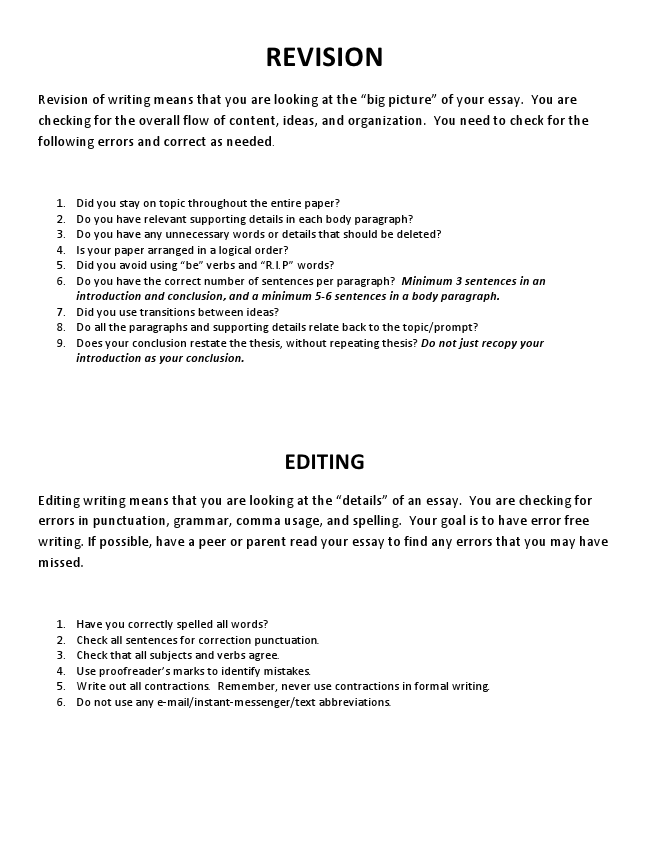
Revision


Sentence Fluency


Sentence Fluency
Sentence Beginnings

Use one of these methods to create variety at the beginnings of sentences to break out of the “subject- verb begin sentence rut.”

1.   Two adjectives:  Intelligent, hardworking students study every night.

2.   Appositive: Margaret, the top student in the class, often goes to the library.

3.   Prepositional phrase:  In the brightly lit classroom, students study for the test.

4.   Infinitive: To prepare for the test is the student’s responsibility.

5.   Gerund:  Listening and studying all day will be the responsibility of the students.

6.   Participle: Having sat in the classroom all day, the students were ready for a snack.

7.   Adverb clause: Until we learned the parts of speech, we didn’t improve our writing.

8.   Adjective clause:  Andy, who has the mind of a scientist, worked in the lab.

9.   Parallel structure:  Tall and handsome, the lifeguard stands proudly.


Hints for improving sentence fluency

Never start two sentences the same way in a paragraph unless it is to create a sense of repetition.

Read the written text aloud.  Often the writer can hear errors when the text is read aloud.

If there is a lack of variety in sentence beginnings, look at the words that appear later in the sentence.  Could they move to the beginning?

If there are too many short choppy sentences, try combining them or adding clauses.

Be careful of sentences that have too many conjunctions or subordinating clauses. Try to avoid “and overload.”

Check the commas.  Lack of commas can cause unclear meaning, and commas used in the
wrong places can lead to choppy sounding sentences.


Words that help build longer sentences

Use these words at beginnings of sentences to make complex sentences.

after although
as as if
as long as because
as soon as before
if even though
once since
so that than
though unless
until when
whenever where
wherever whether
while

Words that slow down the writing

Why say… When you mean…

a large number many
adjacent to next to
at the present time now
being that because
by the use of with
despite the fact that although
due to the fact that because
during the time that while
for the reason that because
in the course during
most of the time usually


Voices you might try to use

Horrifying humorous suspenseful critical persuasive
Sarcastic scholarly thoughtful happy ridiculous
Concerned gloomy childlike frightened informative
Sad rude flighty

Commonly Misspelled Words


Commonly Misspelled Words

A   absence   abundance   accessible   accidentally   acclaim   accommodate   accomplish   accordion   accumulate   achievement   acquaintance   acquire   acquitted   across   address   advertisement   advice   advise   affect   alleged   amateur   analysis   analyze   annual   apartment   apparatus   apparent   appearance   arctic   argument   ascend   atheist   athletic   attendance   auxiliary

B   balloon   barbecue   bargain   basically   beggar   beginning   belief   believe   beneficial   benefit   biscuit   boundaries   business

C   calendar   camouflage   candidate   Caribbean   category   cemetery   challenge   changeable   changing   characteristic   chief   choose   chose   cigarette   climbed   clothes   clothing   cloth   collectible   colonel   column   coming   commission   committee   commitment   comparative   competent   completely   concede   conceivable   conceive   condemn   condescend   conscience   conscientious   conscious   consistent   continuous   controlled   controversial   controversy   convenient   correlate   correspondence   could of counselor   courteous   courtesy   criticize   criticism

D   deceive   defendant   deferred   definitely   definition   dependent   descend   describe   description   desirable   despair   desperate   develop   dictionary   difference   dilemma   dining   disappearance   disappoint   disastrous   discipline   disease   dispensable   dissatisfied   dominant   drunkenness

E   easily   ecstasy   effect   efficiency   eighth   either   eligible   eliminate   embarrass   emperor   encouragement   enemy   encouraging   entirely   environment   equipped   equivalent   especially   exaggerate   exceed   excellence   exhaust   existence   existent   expense   experience   experiment   explanation   extremely   exuberance

F   facsimile   fallacious   fallacy   familiar   fascinating   feasible   February   fictitious   fiery   finally   financially   fluorescent   forcibly   foreign   forfeit   formerly   foresee   forty   fourth   fuelling   fulfill   fundamentally

G   gauge   generally   genius   government   governor   grammar   grievous   guarantee   guardian   guerrilla   guidance

H   handkerchief   happily   harass   height   heinous   hemorrhage   heroes   hesitancy   hindrance   hoarse   hoping   humorous   hygiene   hypocrisy   hypocrite

I   ideally   idiosyncrasy   ignorance   imaginary   immediately   implement   incidentally   incredible   independence   independent   indicted   indispensable   inevitable   influential   information   inoculate   insurance   intelligence   interference   interrupt   introduce   irrelevant   irresistible   island

J   jealousy   judicial

K   knowledge

L   laboratory   laid   later   latter   legitimate   leisure   length   license   lieutenant   lightning   likelihood   likely   loneliness   loose   lose   losing   lovely   luxury

M   magazine   maintain   maintenance   manageable   maneuver   manufacture   marriage   mathematics   medicine   millennium   millionaire   miniature   minuscule   minutes   miscellaneous   mischievous   missile   misspelled   mortgage   mosquito   mosquitoes   murmur   muscle   mysterious

N   narrative   naturally   necessary   necessity   neighbor   neutron   ninety   ninth   noticeable   nowadays   nuisance

O   obedience   obstacle   occasion   occasionally   occurred   occurrence   official   omission   omit   omitted   opinion   opponent   opportunity   oppression   optimism   optimistic   orchestra   ordinarily   origin   outrageous   overrun

P   pamphlets   parallel   particular   pavilion   peaceable   peculiar   penetrate   perceive   performance   performance   permanent   permissible   permissible   permitted   perseverance   persistence   personal   personnel   perspiration   physical   physician   piece   pilgrimage   pitiful   planning   pleasant   portray   possess   possession   possessive   potato   potatoes   possibility   possible   practically   prairie   precede   precedence   preceding   preference   preferred   prejudice   preparation   prescription   prevalent   primitive   principal   principle   privilege   probably   procedure   proceed   profession   professor   prominent   pronounce   pronunciation   propaganda   psychology   publicly   pursue

Q   quantity   quarantine   questionnaire   quizzes

R   realistically   realize   really   recede   receipt   receive   recognize   recommend   reference   referring   relevant   relieving   religious   remembrance   reminiscence   repetition   representative   resemblance   reservoir   resistance   restaurant   rheumatism   rhythm   rhythmical   ridiculous   roommate

S   sacrilegious   sacrifice   safety   salary   satellite   scary   scenery   schedule   secede   secretary   seize   sense   sentence   separate   separation   sergeant   several   severely   shepherd   shining   siege   similar   simile   simply   simultaneous   sincerely   skiing   sophomore   souvenir   specifically   specimen   sponsor   spontaneous   statistics   stopped   strategy   strength   strenuous   stubbornness   studying   subordinate   subtle   succeed   success   succession   sufficient   supersede   suppress   surprise   surround   susceptible   suspicious   syllable   symmetrical   synonymous

T   tangible   technical   technique   temperamental   temperature   tendency   themselves   theories   therefore   thorough   though   through   tomorrow   tournament   towards   tragedy   transferring   tries   truly   twelfth   tyranny

U   unanimous   undoubtedly   unforgettable   unique   unnecessary   until   usable   usage   usually   utilization

V   vacuum   valuable   vengeance   vigilant   village   villain   violence   visible   vision   virtue   volume

W   warrant   warriors   weather   Wednesday   weird   wherever   whether   which   wholly   withdrawal   woman   women   worthwhile   writing

Y   yacht   yield   young